Touche meaning is simple: it’s what you say when someone makes a good point. It’s a quick way to say “you got me” or “fair point.”
The word started on the fencing strip and now lives in texts, debates, and everyday chats. Here is what touché means, where it came from, how to say it, and how to use it.
Table of Contents
What Does Touché Mean? Definition & Slang Explained

Touché is a short word with a big job. It admits that someone else just scored a point.
What does touché mean? It’s an interjection you use to acknowledge a hit in fencing, or a smart, fair, or witty point in an argument. The touche definition is the same on both sides of the Atlantic: “good point, you’re right.”
What does Touche Meaning in slang? In texts and comments, it means “you got me,” “okay, fair,” or “that was a good one.” People use it when a friend turns their own words back on them.
Must visit: OOTD Meaning: Discover the Popular Slang, Definition & How to Use It
Here is how it plays out in real life:
Friend: “You say you hate mornings, but you’re up at 6 every day.”
You: “Touché.”
Why does someone say touche? There are five common reasons:
- To concede a point in a debate
- To compliment a witty comeback
- To admit a fair criticism
- To show good sportsmanship
- To end a disagreement with a smile
Tone matters. Said warmly, it shows respect. Said with a flat voice, it can sound like a polite dig.
It does not mean “you win.” It also does not mean “I’m angry.” It only says, “That one landed.”
Touche Origin and Pronunciation: From Fencing to Everyday English
The touche origin is a sword sport. The word crossed into everyday English more than a century ago. If you want to read Perdition Meaning then visit this site.
Touché is French. It’s the past participle of toucher, “to touch,” which comes from Old French tuchier. In fencing, a fighter calls it out to admit the opponent’s blade made contact and scored a touch. In practice bouts without scoring gear, fencers still use it this way.
The dates vary by source. Merriam-Webster’s records list the first known use in 1897. Etymonline dates the fencing use to 1902 and the figurative use, as a polite nod to a valid argument, to 1907. Either way, English speakers have used it since the turn of the 20th century.
Over time, the “hit” changed from physical to mental. A sword touch became a witty point.
How do you pronounce touché? Say it too-SHAY. It has two syllables, and the stress falls on the second one. The phonetic spelling is /tuːˈʃeɪ/.
Common mistakes to avoid:
- “Toosh”
- “Touch”
- “Too-chay”
Touché or touche? The dictionary-approved spelling is touché, with the accent. Grammarist notes that people often drop the accent online, mostly because accented letters are harder to type. The accent also shows that the word has two syllables.
One more fact: in French, touché also means “touched” or “affected,” as in being moved by a speech or hit by a storm. English kept only the “good point” sense.
How to Use Touche in a Sentence: Examples & Tone

How is touche used? You say it right after someone makes a fair point against you. Keep it short and let the moment do the work.
You can use it in a few different ways:
- Standalone: “Touché.”
- With a name: “Touché, Sarah.”
- Repeated for emphasis: “Touché, touché.”
- With a follow-up: “Touché. I’ll fix it today.”
Here are examples for common situations:
Everyday talk
“You told me to relax, but you checked your phone ten times.”
“Touché.”
Text messages
“Says the person who was late last week. 😂”
“Touché.”
Work and meetings
“We said we’d cut costs, but this plan adds them.”
“Touché. Let me rework it.”
Friendly debates
“If pineapple on pizza is wrong, why do you eat Hawaiian wraps?”
“Touché.”
When touche works best, and when to skip it:
- Do use it for fair, clear points.
- Do use it in casual or lightly funny moments.
- Don’t use it in a serious conflict, where it can sound sarcastic.
- Don’t use it when the other person’s point isn’t actually good.
- Don’t overuse it in formal writing.
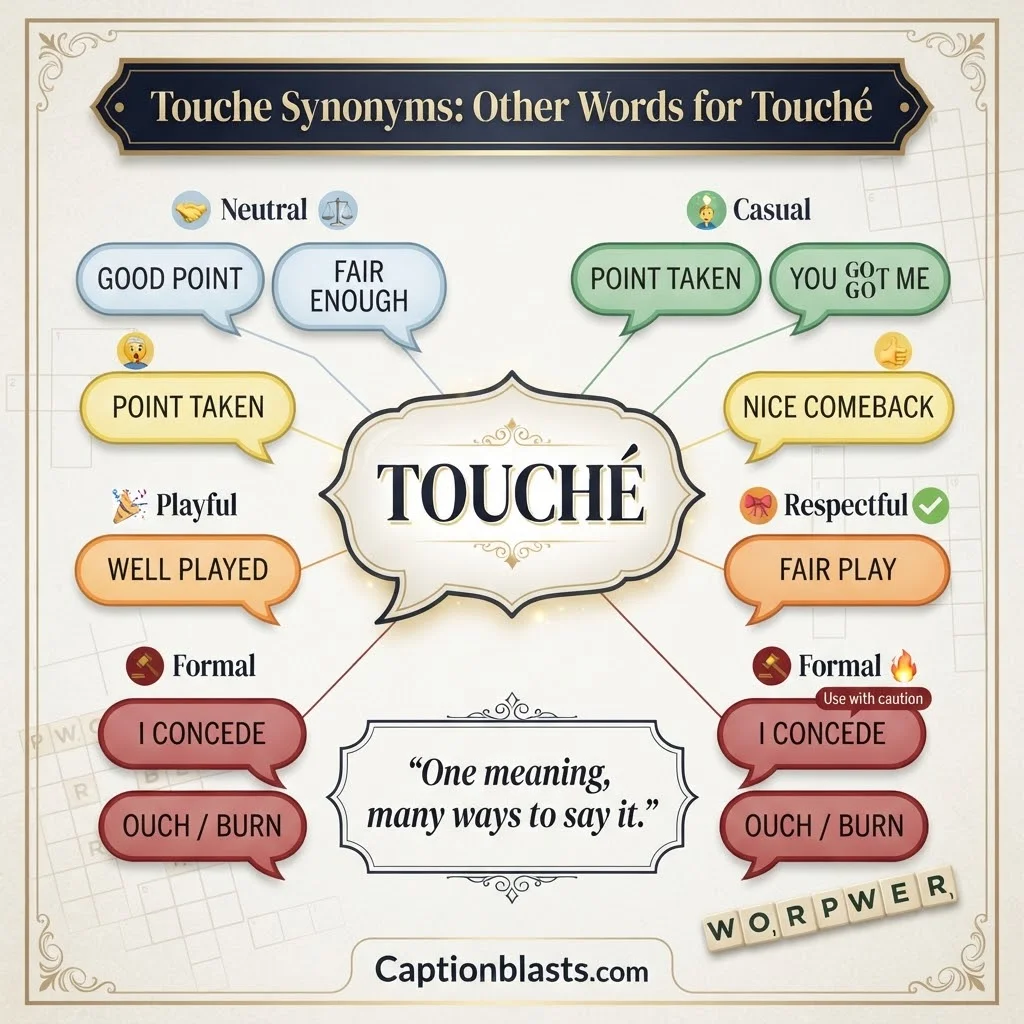
Touche Synonyms: Other Words for Touché

Sometimes you want another way to say it. Here are clear options for every mood.
What is another word for touché? The closest match is “good point.” Other common choices are “fair enough,” “point taken,” and “you got me.”
| Phrase | Tone | Best Use |
|---|---|---|
| Good point | Neutral | Any conversation |
| Fair enough | Casual | Quick agreement |
| Point taken | Neutral | Work and email |
| You got me | Playful | Friends and texts |
| Well played | Respectful | Games and debates |
| Nice comeback | Light | Witty replies |
| Fair play | Warm | Sportsmanship |
| I stand corrected | Formal | Admitting an error |
| I concede | Formal | Debates |
| Ouch / Burn | Slang | Playful teasing |
Touché is the most compact of the group. It says in one word what the others need two or three words to say.
FAQs
What does touché mean in slang?
In slang, touché means “you got me” or “good point.” People use it in texts and comments when someone makes a fair or funny point against them. It’s friendly and playful.
How is touche used?
You say touché right after someone makes a smart or fair point. It can stand alone or follow a name, such as “Touché, Sarah.” It works best in casual talk, texts, and friendly debates.
Why does someone say “touche”?
People say touche to admit another person scored a point. It shows respect, good humor, and fair play. It also ends a small argument gracefully.
What is another word for touché?
Common alternatives are “good point,” “fair enough,” “point taken,” “you got me,” and “well played.” Pick the one that matches your tone.
Conclusion
The touche meaning is clear: “that was a good point.” It began on the fencing strip and now fits any moment where someone makes a point that lands. Say it too-SHAY, keep it light, and use it when the other person has earned it.
CaptionBlasts.com Team is a group of passionate content creators and digital writers dedicated to helping people express themselves through creative and engaging captions.