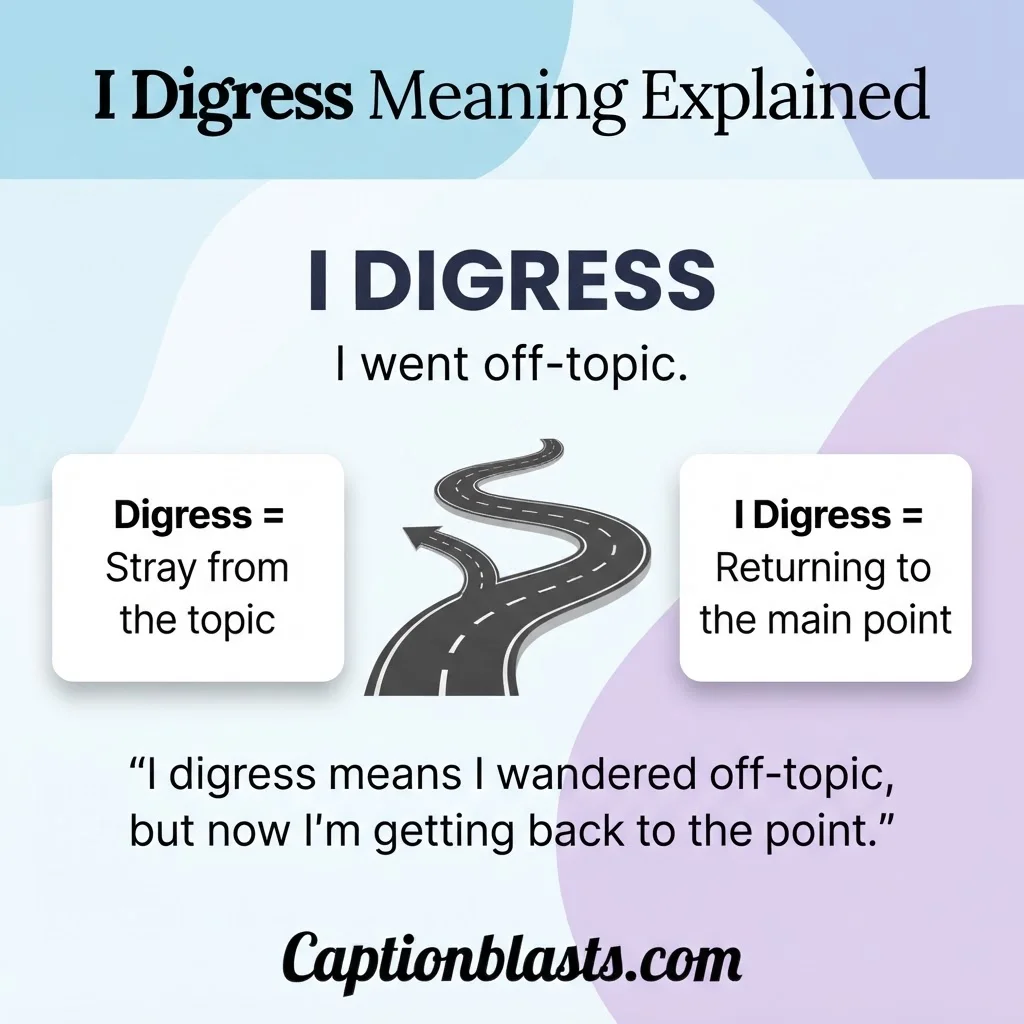
The I digress meaning is simple. You drifted off-topic, you noticed, and you are heading back. This guide explains what the phrase means, where it comes from, and how to use it well.
Table of Contents
What Does I Digress Meaning Really Stand For?

“I digress” is a quick way to admit you strayed from your point. Here is what it means and how it sounds in real life.
What does “I digress” mean? It means “I have gone off-topic.” Speakers use it to flag a tangent and signal a return to the main point.
I Digress Definition in Simple English
Digress is a verb. It means to wander from the main subject while you speak or write. It is an intransitive verb, so it takes no object. You don’t digress something. You just digress.
Here is an example:
“I came to talk about taxes. My cousin’s new boat is amazing, but I digress.”
What Does But I Digress Mean?
What does “but I digress” mean? It carries the same idea. The word “but” acts as a pivot. It says, “I know I strayed, and now I’m back.”
Understanding phrases like “I digress” helps you follow conversations and recognize how context shapes meaning. The same principle applies to abbreviations like FTM meaning, which can refer to gender identity, parenting, or casual texting depending on where and how it is used.
| Phrase | Meaning | Tone |
|---|---|---|
| I digress | I went off-topic | Neutral |
| But I digress | I went off-topic and I’m returning | Often playful |
| I got sidetracked | I drifted by accident | Casual |
Word Forms and Pronunciation
The word has a few common forms:
- Digress: I tend to digress.
- Digresses: She often digresses.
- Digressed: He digressed for ten minutes.
- Digressing: We are digressing again.
- Digression: That was a fun digression.
Say it dye-GRESS. The stress lands on the second syllable. The Oxford Learner’s Dictionary gives the pronunciation as /daɪˈɡres/.
Is I Digress Formal or Casual?
Both. The same dictionary marks digress as a formal verb. Still, people use “I digress” in chats, blogs, and jokes.
Compare these three:
- Formal: “I apologize for digressing.”
- Neutral: “But I digress.”
- Casual: “Sorry, I got sidetracked.”
Where Does I Digress Come From?

Just as “I digress” helps people navigate conversations by acknowledging a change in topic, modern internet slang can also influence how messages are understood. For example, exploring SYBAU meaning reveals how a viral acronym is used in texting and TikTok, and why its tone can sometimes come across as offensive.
The phrase has a long past. Knowing it helps you see why the word still fits so well.
Latin Roots of Digress
Digress comes from the Latin digressus. That word is the past participle of digredi, which means “to go off” or “to depart.” It joins di- with gradi, meaning “to go” or “to step.” You can read the breakdown on Dictionary.com.
Picture someone stepping off a path. That is a digression.
The same root gave English progress, regress, egress, and gradient. Each one is about steps and direction.
Early Use of But I Digress
Dictionary.com lists the first recorded use of digress in the 1520s to 1530s. The Oxford Learner’s Dictionary also traces it to the early 16th century.
The phrase “but I digress” came later. By the mid-1800s, it was a well-known signpost in speech and writing. It is an idiomatic expression that readers still recognize today.
How to Use But I Digress Correctly

Using it well takes three quick moves. Finish the side thought, say the phrase, and return to your point.
How to use “but I digress” correctly? Keep the detour short. Then name the main topic again so your reader or listener never feels lost.
Using I Digress in Conversation
Say it right after a side story. Then pick the main thread back up.
“I was telling you about my new job. The office coffee is awful, but I digress. The team is great.”
Using I Digress in Writing and Blogs
Place a comma or period before it. Then write a short return sentence.
“Trail running keeps me fit, and the playlists are fun, but I digress. The best shoes have strong grip.”
Use it in essays, blogs, speeches, and opinion pieces. Skip it in strict academic papers, where a direct line like “Returning to the main point” reads cleaner.
Using I Digress at Work and in Presentations
A short side note can add useful context. Say “I digress for a moment” to frame it. Then link it back to your slide.
Avoid it in formal reports and client emails. Plain transitions work better there.
Using I Digress in Texts and Social Media
In texts, the phrase sounds playful and self-aware. Pair it with an emoji if you like.
“Started cleaning my desk and found my old headphones 😂 anyway, I digress. Are you coming at 6?”
Other Ways to Say I Digress

Different moments call for different tones. Pick the one that fits your reader.
What can I say instead of “I digress”? Try “anyway,” “back to the point,” “I got sidetracked,” or “as I was saying.”
Casual Alternatives
- Anyway
- Sorry, I got sidetracked
- Where was I?
- Back to it
Formal Alternatives
- Returning to the main point
- To get back on topic
- As I was saying
- Let me return to my original point
Verb Synonyms of Digress
These verbs all mean turning aside. Each has its own shade.
| Word | Shade of meaning |
|---|---|
| Stray | Drift from the subject |
| Ramble | Talk on and on without focus |
| Veer | Make a sharp change in direction |
| Swerve | Turn away fast |
| Deviate | Leave the expected course |
| Diverge | Split into a new path |
| Wander | Move without a clear aim |
The opposite idea is to stay on topic or stick to the point.
Common Mistakes With I Digress

A few easy slips can twist the meaning. Watch for these.
I Digress vs. I Disagree
These two sound alike, but they are not related.
| Phrase | Meaning |
|---|---|
| I digress | I moved away from the topic |
| I disagree | I hold a different opinion |
Say “I digress” for a detour. Say “I disagree” for a different view.
Overusing or Misplacing I Digress
One use per piece is plenty. Too many make your point hard to follow.
Also, don’t say it and then stay off-topic. The phrase promises a return.
Mixing Up Digress and Regress
Regress means to move backward. It shares the same Latin root as digress, but it is not a synonym. Say “digress” when you leave the topic. Say “regress” when you go back to an earlier state.
FAQs
Why do people say “but I digress”?
People say it to admit a tangent, return to the main point, add a bit of humor, and show self-awareness. It tells the listener, “I know I strayed, and I’m fixing it.”
How to use but I digress correctly?
Finish the side thought first. Then say “but I digress.” End by returning to your original topic in the next sentence. Keep the detour short so the main point stays clear.
What can I say instead of “I digress”?
Try “anyway,” “back to the point,” “I got sidetracked,” or “as I was saying.” For formal writing, use “returning to the main point” or “to get back on topic.”
What does “but i regress” mean?
“But I regress” is a playful twist or a common mix-up of “but I digress.” Regress means to move backward, so it is not the standard phrase. To say you went off-topic, use “but I digress.”
CaptionBlasts.com Team is a group of passionate content creators and digital writers dedicated to helping people express themselves through creative and engaging captions.