ETA means estimated time of arrival. It tells you when a person, vehicle or package should show up.
This guide explains the ETA Meaning Explained in text, work and delivery, with simple examples you can use today.
Table of Contents
ETA Meaning: Definition, Full Form & Origin
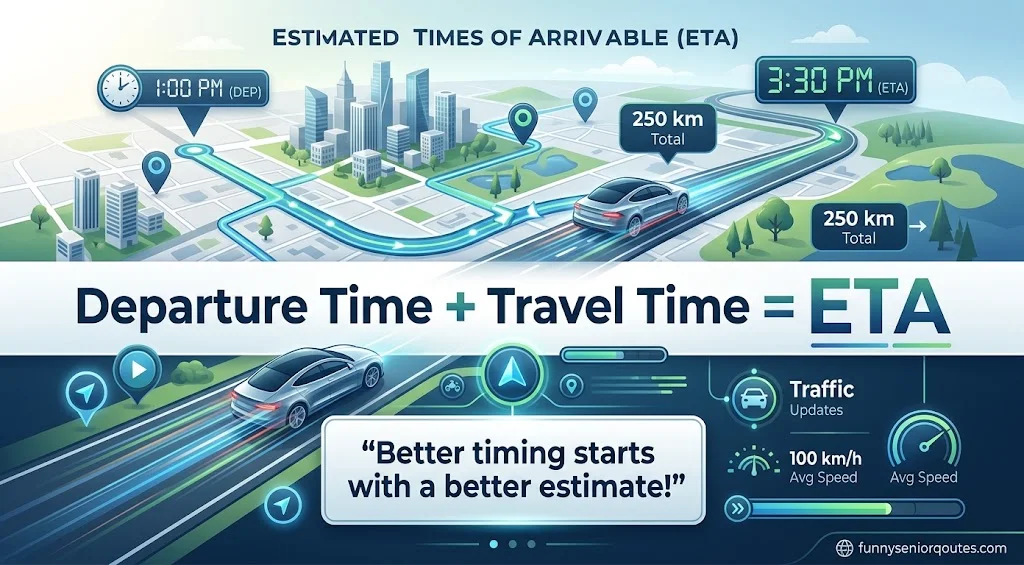
ETA is one of the most common abbreviations in daily life. Here is what it stands for and where else you may see it. Just like ETA helps you understand common abbreviations in everyday conversations, learning expressions from other languages can make your messages more meaningful. For example, understanding the meaning of cariño can help you express love and affection naturally in Spanish.
What does ETA mean? ETA stands for estimated time of arrival. It is the time something is expected to arrive, based on distance, speed and past trips. The Oxford Learner’s Dictionary lists it as the time a plane, ship or other vehicle should arrive.
How do you say ETA? Say each letter: “E-T-A.” It is an initialism, not a word.
Here is a simple example: “The flight’s ETA is 5:00 p.m.” That means the plane should land around 5:00 p.m.
An ETA is a prediction. It changes when the trip changes.
Does ETA have other meanings? Yes. The meaning depends on the context.
- Greek letter: “Eta” is the 7th letter of the Greek alphabet, according to Merriam-Webster. It is written as Η or η.
- Travel permit: Some countries use ETA (or eTA) for an electronic travel authorization. Visitors may need one before they enter.
- Tax law: In Canada, ETA can also stand for the Excise Tax Act.
In everyday English, ETA almost always means estimated time of arrival.
ETA vs ETD, ETC & Other Terms
Understanding ETA helps you communicate clearly about time and expectations, but some words carry deeper cultural and historical meanings. Exploring the Anjin meaning and origin reveals how language connects history, identity, and fascinating traditions.
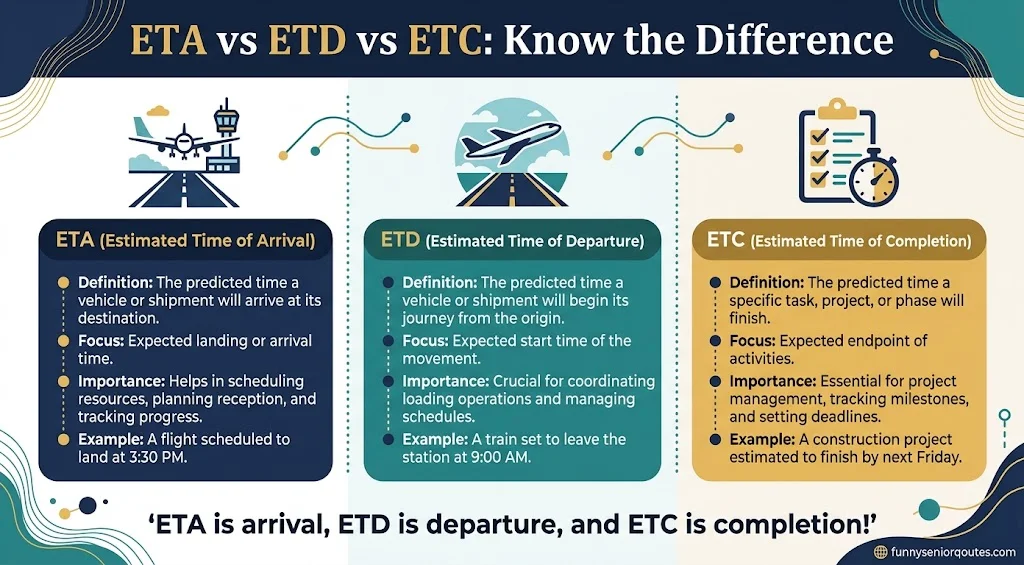
What is the difference between ETA and ETD? ETA is when something should arrive. ETD is when it should leave. Here is a quick guide to the common terms:
| Term | Full form | Simple meaning |
|---|---|---|
| ETA | Estimated time of arrival | When it should arrive |
| ETD | Estimated time of departure | When it should leave |
| ETC | Estimated time of completion | When the task should be done |
| ETS | Estimated time of shipping | When it should ship |
| ETT | Estimated transit time | How long the trip takes |
| ATA | Actual time of arrival | When it did arrive |
| ATD | Actual time of departure | When it did leave |
Does ETD always mean departure? Not always. Most people use ETD for departure. Some online stores use it for “estimated time of delivery.” Check the context before you rely on it.
What is another word for ETA? You can say expected arrival time, arrival estimate, projected arrival or scheduled arrival. In a casual chat, “when do you get here?” works too.
Is an ETA a promise? No. An ETA is an estimate. Traffic, weather or a delay can change it.
ETA Meaning in Delivery, Travel & Logistics
ETAs run modern shipping, travel and transit. Here is how they work and why they change. ETA Meaning Explained.
Where do you see an ETA? You see one almost every day:
- Online orders: USPS, UPS, FedEx and Amazon show an estimated delivery date.
- Food delivery and rideshare: Apps show a live arrival time.
- Map apps: GPS shows when you will reach your destination.
- Flights, trains and buses: Boards and apps show expected arrival times.
How is an ETA calculated? Most systems use a simple formula:
Estimated departure time + estimated transit time = ETA
For example, a parcel leaves on Monday. The trip takes three days. The ETA is Thursday.
Real systems add more data, such as distance, carrier, shipping method, weather and traffic. Real-time tracking helps keep the number current.
Why does an ETA change? Many things can move it:
- Bad weather or heavy traffic
- Customs checks on international parcels
- Carrier delays and busy peak seasons
- A wrong address or a missed delivery
- Human error
How big is the logistics system behind your ETA? It is huge. The U.S. Census Bureau reports that U.S. shipments reached 12.2 billion tons in 2022, worth $18.0 trillion. A small error in an ETA can ripple through that supply chain.
Disruptions are common, too. The McKinsey Global Institute found that companies can expect supply chain disruptions lasting a month or longer every 3.7 years, on average.
How do you read a delivery ETA? Look for a single date or a delivery window. A window means the carrier expects the package any time in that range. Then check the status:
- In transit: The package is moving.
- Out for delivery: It is on the truck and should arrive today.
- Delayed: The carrier expects a later date and may show a new ETA.
What should you do if the ETA has passed? Take three steps:
- Open the tracking page and look for a delivery exception or a new date.
- Check your address, mailbox, porch and building mail room.
- Contact the seller or the carrier if the status does not change.
ETA Meaning in Text, Work & Real-Life Examples

People use ETA all day in texts and emails. These examples show how to use it in a clear and polite way.
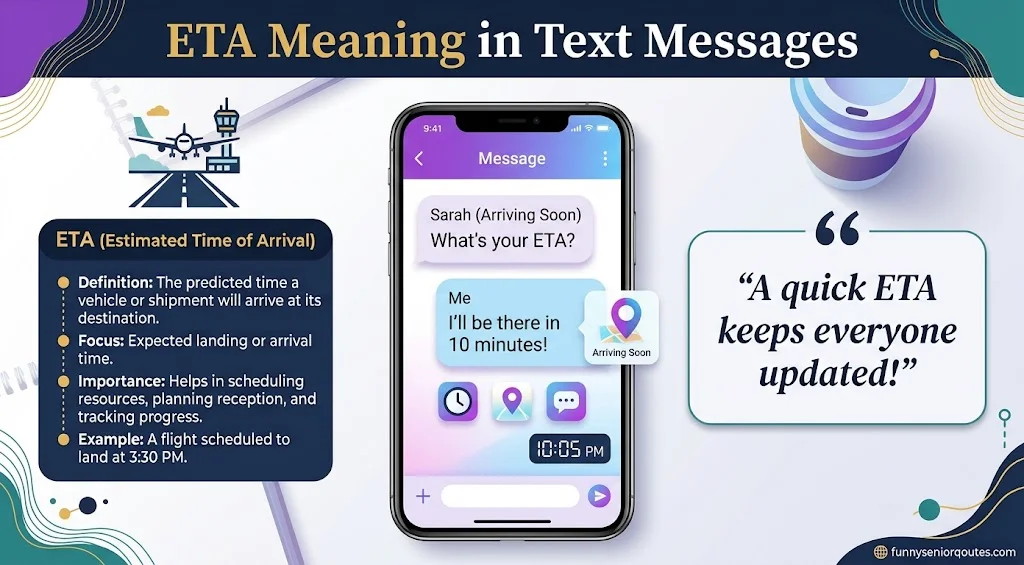
What does ETA mean in a text message? It means “estimated time of arrival.” People use it to ask or say when they will get somewhere. Here are four short examples:
- “What’s your ETA?” — “About 10 minutes.”
- “ETA 6:30. Save me a seat.”
- “Traffic is bad. New ETA is 7:15.”
- “Any ETA on dinner?” — “Twenty minutes!”
What does ETA mean at work? It is the expected time something will arrive or be ready. That can be a shipment, a report or a deliverable. Here are four short examples:
- “What’s the ETA on the report?” — “Friday at noon.”
- “The supplier’s ETA is Tuesday morning.”
- “ETA for the fix is two hours.”
- “Can you share an ETA for the update?”
Some teams use ETC or a due date for tasks. If you are not sure, ask what the team means.
Where else do people use ETA? You will hear it in everyday life, too:
- Meeting a friend at a coffee shop
- Waiting for a rideshare to pull up
- Tracking a pizza or a package
- Planning a pickup at the airport
How do you use ETA politely? Follow three simple tips:
- Give a realistic time. A late ETA feels worse than an honest one.
- Send an update if the time changes.
- In formal emails, write “estimated time of arrival” or “expected arrival” in full.
What are common ETA mistakes? Avoid these:
- Treating an ETA as a deadline or a promise
- Mixing up ETA and ETD
- Giving a time without a time zone when the other person is far away
FAQs
What is the ETA for delivery?
The ETA for delivery is the expected date or time your package will arrive. You can find it on your tracking page, in your order email or in the carrier’s app. It is an estimate, so it can change if there is a delay.
What does ETA mean in a text message?
In a text message, ETA means “estimated time of arrival.” People use it to ask or say when they will get somewhere. For example, “What’s your ETA?” means “When will you get here?” A short reply, like “10 minutes,” works well.
What is an ETA in work?
At work, an ETA is the expected time something will arrive or be ready, such as a shipment, report or update. Some teams use other terms for tasks, like ETC or due date. If the meaning is unclear, ask your team to confirm.
What is another word for ETA?
Another word for ETA is “expected arrival time.” You can also say arrival estimate, projected arrival or scheduled arrival. For finish times, people use ETC or due time. For leaving times, they use ETD.
Conclusion
ETA means estimated time of arrival, and the meaning stays the same in texts, work and delivery. Treat every ETA as a good estimate, and check for updates. When in doubt, ask for a time and share your own.
CaptionBlasts.com Team is a group of passionate content creators and digital writers dedicated to helping people express themselves through creative and engaging captions.